Product

appropriate.health
Guideline-based clinical decision support for diagnostic imaging referrals.
An ordering clinician types the clinical question in plain language. The platform is integrated into the electronics medical record system (EPIC currently integrated); it analyzes the patient's medical information from the electronic medical record and matches the clinicians request against the encoded guideline corpus and returns the supported imaging pathway — ranked, with its evidence grading and its conditional next steps. Where a prerequisite is missing from the referral, it asks for it rather than guessing. Where the case is genuinely ambiguous, it says so and routes to human review.
How it works
- 01
Indication entered
- 02
Scenario matched
- 03
Ranked recommendation returned
- 04
Missing qualifier prompted
- 05
Decision and rationale logged
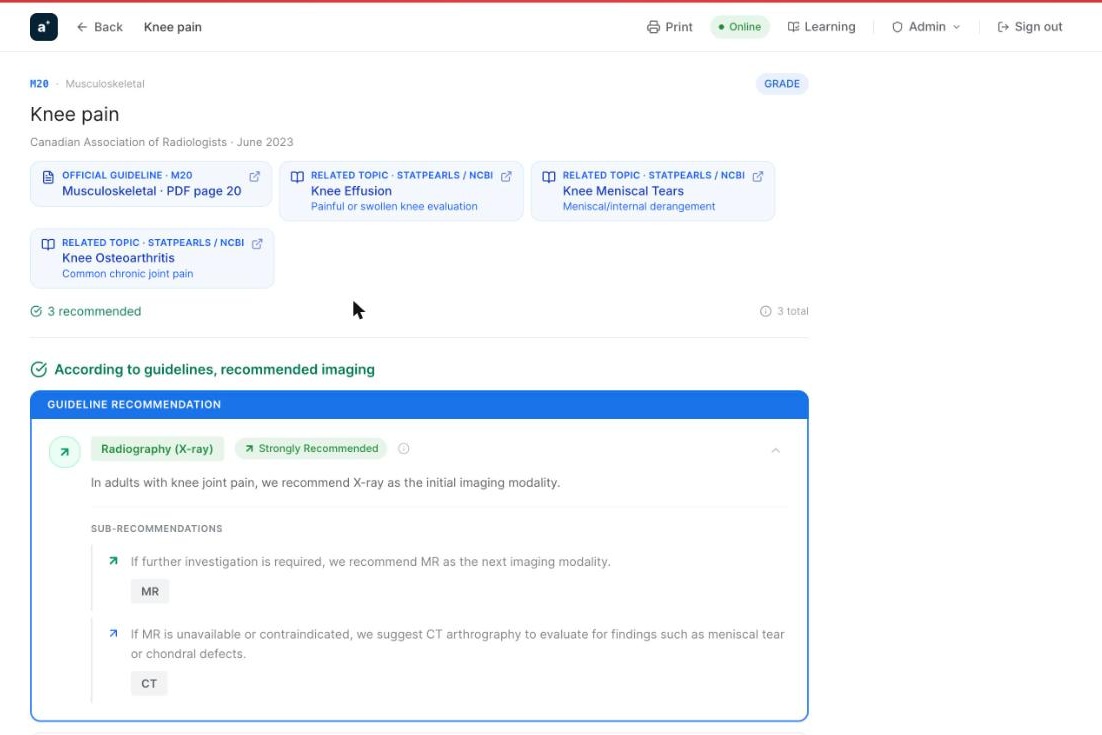
Sourced
Each result shows its guideline scenario code, clinical domain and publication date.
Graded
GRADE evidence strength appears on every recommendation, with the source guideline one click away.
Conditional
Sub-recommendations carry the real clinical logic: the next study if further investigation is required, the alternative if the first is unavailable or contraindicated.
The platform advises, the clinician decides
appropriate.health does not approve, deny or modify an imaging order. Where the referral text is too vague to map confidently to a single pathway, it abstains rather than forcing an automated conclusion, and those cases are held in a radiologist-governed review lane. Every recommendation shown, every decision taken, and every override and its rationale is recorded. If a referral is ever questioned, the reasoning is retrievable.
A learning record
Guideline review carried out in the ordinary course of ordering is captured as a reviewable Section 2 learning record. The physician decides the time claimed, edits every learning statement, and submits the record themselves. Educational content review is recorded as an unaccredited Section 2 classification; credits are not awarded by the platform, and eligibility remains the physician's responsibility.
Built to deploy
- Zero footprint
- Cloud-based. No client install, no on-premise server, no local database.
- EMR-integrated or standalone
- Integrates with your EMR or RIS through FHIR and HL7, with patient context retrieved live — and can also run entirely without one, which is how much of Canadian community imaging operates.
- Standards
- FHIR, HL7 and DICOM.
- Data residency
- Hosted entirely in Canada on Google Cloud Platform.
- Privacy
- PIPEDA and HIPAA compliant. Personal health information is stripped at intake by an automated de-identification layer.
- Access
- Enterprise single sign-on and two-factor authentication.
- Audit
- Sessions, security events and patient access logged separately, exportable for the institution's own review.
We can provide a full security and privacy package on request. Request a briefing